Wednesday, 29 August 2012

mourning cloak & camberwell beauty...

I was interested to discover in our book that the mourning cloak butterfly -Nymphalis antiopa- so admired by myself and Jennifer in a park in New York in June (read more here) is the same species as the camberwell beauty which can sometimes be seen here in the UK, being a rare migrant to our shores.

It's so hard to believe that such seemingly fragile creatures actually can migrate, but they can and do...

The monarch butterfly in Canada and northern states of the USA is the best-known example - it makes a 3,000 mile journey south each year to overwinter in Mexico and California. A number of species that we see here in Britain are migratory too - red admiral and painted lady butterflies and silver-Y and humming-bird hawk moths all travel to us in the spring from as far away as north Africa and southern Europe.

Read more about the camberwell beauty on this excellent website - www.ukbutterflies.co.uk, in association with Butterfly Conservation.


mourning cloak butterfly, New York, photo taken by Jennifer Alexander, 17th June 2012


Friday, 17 August 2012

My Favourite Place in Scotland

I've just posted my entry to BBC Radio Scotland's Out Of Doors Programme and Scottish Book Trust competition to write about 'my favourite place in Scotland' in 1,000 words or under.

Here's my entry:


............................................

My Favourite Place in Scotland 

What a difficult task the Out of Doors Programme and Scottish Book Trust have set.

To write about 'my favourite place in Scotland' sounded simple enough, until I actually started to think... Just what is my favourite place?

I know – Orkney! I've been only twice but long to go again: birds, sealife, incredible coastal cliffscapes. Gentle inland farms, numerous small isles. Ancient history, archaeological digs. On the Brough of Birsay tidal island it all comes together as fulmars and rock doves glide and dive around sheer flagstone cliffs. A wheatear flitted amongst the stones of the 12th-century monastry (built atop a 9th-century Viking settlement). There's a Pictish stone there that's older still.

The Ring of Brodgar stone circle - Jennifer and I cycled here aided by a powerful tailwind. Returning to our Bay of Skaill cottage the tailwind became a headwind too strong to cycle in. Mrs Poke's husband collected us in his farm truck. In nearby 3,000 year-old Maes Howe chambered tomb the Historic Scotland ranger mistook us for a married couple, discovered we weren't and offered to perfom the ceremony there and then. The awkward situation was averted when I pointed out that we had no cake.

Rackwick Bay on the Isle of Hoy - Stopping part way at the huge Dwarfie Stane - what apart from faerie magic could possibly have so crisply carved its two-celled interior? The walk from Rackwick to the Old Man sea stack - mountain hares in mahogany-grey-white summer coats watched us intelligently. Great skuas -bonxies- circled overhead. At the headland fulmars wheeled below and beside us.

In Kirkwall we marvelled at the red sandstone of St Magnus Cathedral and had hot chocolate and a kitkat each in a quiet church cafe.

In Stromness we ate wholemeal pasta in the living room of our hostel and played Scrabble as the evening sky darkened outside. Quirky buildings, giftshops and galleries of the cobbled main street. Elegant stringed instruments in a window near the museum. Artist Tim Wootton in his wildlife art gallery - told me of a Sandhill Crane sighted on a nearby island. Cycling out of the town to look at fossilised wave-ripples on a flagstone shore. From a derelict gun emplacement I sketched a distant lighthouse and watched curlews that flew low across the waves.

That's Orkney.

I also rather like the area around Montrose, where my mum has a static caravan. Miles of pristine white beaches, river estuaries, red-earth landscapes. Just walking up the dunes from the caravan you spot eiders and cormorants, guillemots and gulls. In spring and summer terns flap balletically and scree scree their creaking calls as they dive for little silver fish. Come here if you're into birds - the Scottish Wildlife Trust's Montrose Basin visitor centre overlooks the tidal lagoon. One evening they led a dusk walk and a brown hare came leaping and bounding towards our group, closer and closer through stubble field, completely unfazed. We listened to pipistrelle bats on electronic detectors then walked in the dark to the old Bridge of Dun where a tawny owl glided silently away towards a group of barns.

In woodland above the Basin a ruined mill offered its treasures in the stream that bubbled below what must have been a midden. Coloured glass and copper buckles, pitted and greening. Clay marble stoppers to keep the fizz in lemonade and a glass jar with three bears prowling around its sides - one little, one middle, one large. A white doll figurine less than an inch high - to carry in a purse, or hide in a special steam pudding?

Yes, Montrose is the place.

Or... what about the north-east coast, between Aberdeen and Peterhead... The cliffs are what you go here for. Arches and caves and a giant stone-walled cauldron known as 'the pot'. A mile or two north of Cruden Bay are the ominous ruins of Slains Castle. You can see why Bram Stoker was inspired to write Dracula here. The drop from the tallest tower is the height of the castle then the same again, down near-vertical rockface to crashing waves below. On a spring day I painted here and counted 15 bird species in an hour. Short-eared owls flew to and fro, rising from coarse grasses to quarter over field and cliff. One came directly towards me and hovered above for a few wingbeats before uttering a single shrill shriek and flying back the way it had come. I don't know whether or not I passed its test …

Below the cliffs between Cruden Bay and Peterhead boulder-floored caves resonate with the otherworldly wails of colonies of seals. If any map should still show the words 'here be dragons' it's the Ordnance Survey Explorer 427 of Peterhead & Fraserburgh.

And seabirds nest all around - razorbills and kittiwakes, guillemots and shags, lesser and greater black-backed gulls. Fulmar and of course the iconic -and comic- rainbow-beaked puffin. My best ever views of a peregrine falcon - a lone bird sitting surveying the grasslands. I sketched it over and over before it flew to the cliffs to give me perfect close-up views of its cadmium yellow talons and eye ring, its puffed white chest speckled with dark and that wonderful but terrifying hooked bill.

Shortly after the peregrine I heard far below a splashing blow... A whale! I looked just in time to see a long blue-black shape slide below the water, heading north. Rushing that way I saw its dark mass break the surface several more times, ploughing a straight line through calm water. Finally the curved blades of the tail flipped right up vertically before the whole thing disappeared completely. It must had dived.

But wait, I nearly forgot - Linlithgow, my hometown! Our winter starling roost in the station monkey puzzles, and the springtime displays of great crested grebes on the Loch...

Oh dear.

Is it cheating to say that Scotland is my favourite place?


Wednesday, 15 August 2012

Loch Awe to Cruachan Dam, castle & kirk


Another great day out on the West Highland Lines can be had from Loch Awe, 40 minutes by train from Oban or two and a half hours from Glasgow. Travelling south from Oban you go through the Pass of Brander where the rails run beside and above deep black water, hemmed in on both sides by steep scree slopes. It reminds me of the Symplegades clashing cliffs that Jason and his Argonauts adventured through & defeated in their quest fro the golden fleece. Loch Awe station comes soon after the waters of the pass start to widen into the sweep of the loch itself.

I spent half an hour absorbing the scene and sketching Kilchurn Castle from a little disused landing stage down by the water. Beside me was a railway carriage used as self-catering accommodation and in a ragged pine above was a raven. Across the surface of the water honking geese flew in ones and twos, and one solitary cormorant. In tree nearby were chaffinches, goldcrests and house sparrows, and two blue tits that flew in a frenzy then came together to consummate their courtship dance.

As this was my first visit to Loch Awe I headed to the village store to see if I could pick up any tips. I was given a very friendly welcome by the woman behind the counter who suggested a well-managed track that runs into the hills to Cruachan Dam. Total distance - 6km from station to dam. This sounded about right considering that I wanted enough time to stop and get some drawing done. I left the shop and immediately bumped into Jim who was busy working outside his cottage. Jim has taken on the upkeep of the Loch Awe station platforms under ScotRail's Adopt-a-Station scheme. We hadn't met before but were aware of each other through our contacts with ScotRail. We had a brief chat then I set off on my walk.
 

looking across Loch Awe to Kilchurn Castle, pencil & watercolour in sketchbook, 14.5x41cm


looking across Loch Awe, pencil & watercolour in sketchbook, 14.5x41cm

.............

The walk 

Head south-west along the A85 road for a little over a kilometre until you come to St Conan's Kirk on your left. If you've got time -and I suggest you make sure that you do- go in for a look around. Entry is free but there's a donation box and an interesting little leaflet to buy that tells about the building. At first glance you think the church is old but in fact it was completed in 1930, less than a century ago. It's an eccentric amalgamation of Gothic architecture ... mediaeval monastic style ... the little sheltered courtyard of an abbey ... it has gargoyles galore, to rival Notre Dame, and a set of eight dark-wood heraldic seats, details picked out in gold. Look for an owl too, and some intricately carved head studies. The eastern end of the church has a smooth curved wall with full height non-stained-glass windows that offer a beautiful sweeping view across railway and loch. It was difficult to drag myself away from such a fantastical place. 


a rather serious-looking person, St Conan's Kirk


looking down & across Loch Awe


a lichened boulder far above the Pass of Brander


approaching Cruachan dam


Directly after the church, on the right-hand side of the A85 a smaller road starts to lead uphill. This is the way to the Cruachan Dam and once you're on it you can't get lost. It isn't open to public vehicles so it's nice and quiet. As it bends upwards along the edge of the hills it offers some quite stunning views across the valley and the Pass of Brander below.

I was surprised that once I was up on the hillside I saw very little wildlife, only a few crows and hooded crows. At least it meant I got quickly to my destination. Walking fast it wasn't much more than an hour before I found myself confronted by the sight of a huge hydroelectric dam nestling in a great corrie, hugged on three sides by typical highland hills. 

I walked to the far end of the dam and did a quick sketch in pencil of the view across the dark lochan waters before retracing my steps to Loch Awe village. If you had all day you could keep walking beyond the dam and high up into the hills. The summit of Ben Cruachan can be reached from here.


the reservoir lochan at Cruachan Dam, pencil & watercolour in sketchbook, 14.5x41cm      

 
I got back to the village in time for half an hour chatting with Jim. We shared a beer and talked about the wildlife and history of the area. 

Finally, back at the station waiting for the evening train home I stood on the passenger footbridge and sketched the curved rails and old railway cottages.


Loch Awe railway cottages, pencil & watercolour in sketchbook, 14.5x20.5cm


N.B. In summertime Falls of Cruachan station is open, giving access to the Cruachan visitor centre. Directly downslope of the dam, the station is a request stop between Loch Awe and Taynuilt. I hope to go back to visit the centre with its tunnels under the mountain, and to try the steeper walk directly up the hillside to the dam.


Tuesday, 10 July 2012

New York galleries & birds then an Atlantic crossing on the Queen Mary 2... more birds... dolphins... & whales...


looking down on the prow from open-air deck eleven, underneath the Captain's bridge. watercolour in sketchbook

Jennifer and I recently spent seven days and nights crossing the Atlantic by ocean liner. It was an amazing trip.

This is far from my normal type of holiday - Cunard's Queen Mary 2 is an absolute luxury ship, modern but harking back to the 1920's & 30's when Art Deco ruled. Basically she's a floating high-starred hotel. A last-minute offer gave us a pretty good price compared to what you'd pay for return flights to New York plus seven nights accommodation with full board. It was so much more satisfying than flying. 

standing on the prow. watercolour in sketchbook


New York

New York overwhelms with its galleries and museums - the Guggenheim... MoMA... the Met... the American Museum of Natural History. I could have happily spent my five days within the walls of those last two. If there wasn't so much else to see...

Central Park is huge and remarkably good for birdwatching. Unsurprisingly there were numerous house sparrows, starlings and pigeons, all just like we have here. But also:
American robins - named by homesick early settlers from Europe but in fact more closely related to our blackbird than our own red-breasted robins.
Northern cardinals - little hopping pirate birds in bold red coats with a slightly spiked hairdo and black eye patches and beard.
A hawk ('red-shouldered' perhaps?) - as large as a buzzard it sat motionless in a tree whilst various songbirds frantically attempted to drive it away. Unknown Orioles in stunning gold and black plumage were swooping continually at the hawk, actually striking it with their beaks - yet it still didn't move.

In nearby Morningside Park (a reminder of Edinburgh!) we saw a beautiful black-crowned night heron that skulked at the reed edge.
Nearby on a rock - the closest I've ever been to a cormorant. What an amazing jewel-blue eye. Red-eared terrapins swim together in all the ponds and pools, emerging from the water to clamber lazily across one another as they seek the optimum sunspot.

Once the torrential rain of our first two days had subsided we saw a good assortment of butterflies. Some were species we get here - small whites, green veined white, perhaps a comma and perhaps a red admiral. The tortoiseshells are a different type to ours. Most striking of all was a large and dark butterfly we didn't know, the wonderfully named 'mourning cloak'. Metallic maroon with a pastel yellow border to the wings and a row of aqua-blue dots running above, the same colour as the cormorant's eye.

Several times we saw racoons which in Central Park scavenge around the waste bins as squirrels do here, or like foxes in our bigger cities. They were almost totally unfussed by human presence, even by a group of tourists that peered right into a bin at one.

One evening we sat on a bench in the dusk eating cupcakes (don't tell) and watched fireflies glowing gently over the grasses. The colour and effect is exactly that of yellow LEDs turning silently on and off. They're incredible, unreal. To man before electronics they must have been more amazing still.


Then onto the boat:

from the stern of the ship, above the open-air swimming pools. watercolour in sketchbook

The Ocean Crossing

Queen Mary 2 is huge, taking up to 2,620 passengers and 1,253 crew. Our cabin (stateroom is the term used) had a balcony that looked directly onto friendly orange lifeboat 'Hamilton 8'. Lots of entertainments are provided - cinema, library, planetarium, lectures and two corridors of board game tables. A gym and swimming pools. Dancing performances and lessons. Numerous musicians. The best of all was a group of six actors from RADA who brilliantly performed Canterbury Tales and the Merchant of Venice. 
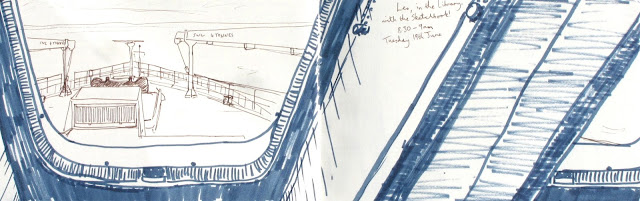
in the QM2 library - one of the few times I felt sick!.. high up and at the very prow of the ship. coloured pen

Even just chatting with fellow passengers is a nice and regular happening:
There was Kim and his wife Jennifer (she a writer of historical fiction) who were travelling to their current home in Germany after a year back in the States;
Dennis and Janet, biologists on their way to visit Charles Darwin's Down House in Kent. Excited to meet people who'd been there and could enthuse about it (we visited last year and thoroughly enjoyed);
A Scottish couple and two daughters, moving back to Edinburgh after living in the States. She and Jennifer (of Leo & Jennifer, not of Kim & Jennifer!) had attended the same school.

container ship passing, mid-Atlantic. watercolour in sketchbook

I did sketches in pen and some quick watercolour studies but most often I just wanted to walk on deck and look out at endless miles of waves. The more time spent out there the more likely it was I'd see something. There was quite a lot of wildlife but for two or three days in a row I didn't see any other sign of man, no passing ships. It feels quite amazing to be in the middle of the ocean, alone and days from land. (It feels even more amazing when you're looking at that whilst sitting in one of the on-deck swimming pools!)

from the stern of the ship (2), above the open-air swimming pools. watercolour in sketchbook

Despite being so far from land there were birds to see. Fulmars and great shearwaters were the two most common. At times among the shearwaters there were some much smaller dark birds (all dark?) which were some sort of petrel but I couldn't ever identify. There were a few gulls but none seen well enough to identify either. A few all-dark skuas except for a white patch towards the end of each wing. Two followed one-another in high and low swoops, seeming friendly rather than hostile. In the UK I'd say they were great skuas, 'bonxies', but looking at the north-east America books it seems there are other possibilities.

Both fulmars and shearwaters came really close to the boat. Fulmars following us but shearwaters flapping up and away as our bow wave started to ripple their ocean resting places. The shearwaters look the larger of the two, but only just. They fly low, taking advantage of wind to increase speed and glide low and fast in zigzagging flight, wingtips skimming the waves.

shearwater sketches & notes, sketched from my photos whilst sitting in the board-game corridor. pen & pencil

Often we saw dolphins or/and porpoises but we couldn't ever decide what species. In books borrowed from the cosy library on deck 8 we learned there are many to choose from. Sometimes we'd see a whole large pod of them. One particular evening as the sun set below the horizon around 8:30pm (on the west to east crossing the clock moves forward an hour every day) the whole sea turned to molten metal. Smoothly rippling yellows and silvers and blues. Dolphins kept appearing all around. Almost always they were in groups of several but often in groups of many more. It was difficult to count but one gathering had at least 40 separate animals. Scanning across the sea with my binoculars I could see them dotted all around, as far away as 10x42 magnification would allow. Sometimes they were just white turbulence on top of the water, sometimes fins were rising above, sometimes sleek or squatter bodies would leap fully out of the waves. 

unidentified dolphins or porpoises, from the QM2 one beautiful evening

And most exciting of all, the same evening, amongst all these dolphins - sperm whales!! At least two. A curved right-angled nose would appear, then a long stretch of sleek wet dark, then a shallow fin, then another long length of dark body. One of them, after all that flesh and fat and blubber had slid across the water, showed its tail, raised it perfectly upright, gave it a flick and dived down below the waves.

me painting on QM2, below the Captain's bridge, knowingly photographed. photo by Dennis Kolesar

me painting at the prow, unknowingly photographed! photo by Jennifer Alexander


A brilliant trip.

Next time I hope we can take the boat both ways.


looking down on the prow from open-air deck eleven, underneath the Captain's bridge. watercolour in sketchbook


Saturday, 7 July 2012

Yesterday afternoon I watched an osprey


I treated myself to a two hour walk up-river from Perth railway station before attending the opening of the summer exhibition at the very friendly Frames Gallery.

I've walked this once before, four or five years ago when I broke my journey on the way to Aberdeen to visit Jennifer. I remembered looking across the wide Tay to grand houses with long gardens that run down to the river. This time it was just as idyllic - lounging chairs, summerhouses, a little boat in the water. The one negative was two jet skiers zooming back and forth, looking like they were having a great time but their machines spraying up great amounts of water and creating huge wakes. Surely not good for any birds still nesting along the water's edge?


I walked only 2 miles upriver, 2 miles back, yet in this short stretch there was a great variety of birdlife:

Heard but not seen was a peacock, crying out, so haunting, on the opposite side, in the grounds of Scone Palace towards the furthest point of my walk.

Swifts and swallows, sand martins and house martins, all over, flying low and high, together and apart, up and down over the water as they hawked for insects.

Black headed gulls with their raucous squawks, but I like it.

Herring gulls and lesser black-backed gulls. Mallards of course, and mute swans. A buzzard circling high and quite far off.

A sandpiper on a little boulder-stone close to the opposite bank, whistling a melancholic call then joined by another.

Herons - six or seven in one small stretch. Some were juveniles with their darker plumage, waiting in the shallows and watching how their parents stalk.

Goosanders or red-breasted mergansers. (I must have been slacking as I didn't realise until I got home that I hadn't even subconsciously registered which.) A mother seemed to be teaching her eight youngsters, having them swim all together, splashing rapidly across the water, then heads down and continuing under the surface with just tails sticking slightly up. Then the frantic above-water splash again. Then heads and bodies under. Repeating this over and over.

Various corvids including two crows on the far shore, searching the sand for I don't know what. Mingling with oystercatchers of which there were many.

At least three separate whitethroat territories, a solitary bird perched in a patch of scrub or hawthorn or other wild-growing bush in each, singing his chirruping song.

And best till last - the osprey. Only the second time I've seen one. Sitting amongst long grasses on the river bank to eat my tea (nice brown roll with broad bean & asparagus houmous and thickly-sliced cucumber) when suddenly in the air the noise level increased and I saw the outline of a bird of prey with gulls and swifts, swallows and martins, all flocking around it, oystercatchers flying at it. As it got closer and closer and I started to realise it certainly wasn't a buzzard, nor a large gull, it was looking like an osprey. Flapping flapping, then gliding, half hovering. Flapping flapping, then gliding, half hovering. It came directly above me and performed this half hover whilst all the time I watched it perfectly through my binoculars.

Four times it folded its wings -tucking them in, but not quite fully- made a rolling turn then dived to splash impressively into the river, submerging itself completely. Three times it had no success, emerged with nothing and flew a little distance before shaking an osprey-worth of water from its feathers. On the fourth dive - a fish! Flattish I think and quite small, probably under a foot in length.

The fish hung hooked below its talons. One foot behind the other as it flew (imagine the pose of a teenager riding a skateboard, only the teenager is an osprey and the skateboard is a fish) the bird shook its feathers dry again then flew off through then above the trees of Scone Palace. I watched until it wasn't much more than a speck. Even then gulls were still chasing it.


As I had neither sketchbook or camera with me on this trip these words will have to do. Plus two quick drawings of young mergansers in on a lake in Quebec in Canada, made when I was in my left-handed phase!


merganser studies. Quebec, Canada, July 2010. left-handed, in pen


merganser group. Quebec, Canada, July 2010. left-handed, in pen


Thursday, 31 May 2012

A donation to Art in Healthcare, & two new paintings of the Aberdeenshire coast (including... birds!)


Four or five years ago I became aware of Art in Healthcare, a charity that sources original artworks for the wards and corridors of hospitals and medical centres. I've been lucky to not often have call to be in hospital, but I still know that art on walls makes a huge difference to the feel of such places. Drawings and paintings and photos brighten and bring interest. They prompt and allow the mind to wander for a few moments from the anxiety of health. This is a charity I'm delighted to support...
Two or three years ago it crossed my mind that I might donate something to the AiH collection.
About a year ago a member of the Board suggested I might like to do the same.
Six months ago I contacted them with the offer of two donated paintings.
Three days ago I finally got round to delivering them! 
Here they are:


coastal defences, Aberdeen, 50x50cm, acrylic on canvas


I painted these two pieces a number of years ago as part of a series looking at the coastline between Aberdeen and Peterhead. My mum was born and brought up in Peterhead and Jennifer (my girlfriend) studied at Aberdeen Uni, so I know the area well. It's a fantastic stretch of coast, really varied in terms of scenery and a huge amount of birdlife.


Directly north of Aberdeen are long swathes of white beach - old wartime bunkers and lookout-posts emerge at odd angles from the sand.

The estuary at Newburgh is spring nest site for sandwich and arctic terns, plus a few common and little. Thousands of eider ducks feed, court, and raise young here and at one point earlier this year the grey & common seals numbered at least five hundred;

Beyond Cruden Bay the ruins of Slains Castle stand on the cliffs - supposed inspiration for Bram Stoker's Dracula. Fall from some of the windows or towers and you'd plummet directly down to waves far below;

Incredible cliffs at the Bullers of Buchan include a most amazing collapsed sea cave - a sea-filled bowl with vertical rock sides and waves pouring in and out through a small archway.


coastal defence, Aberdeen, 50x50cm, acrylic on canvas


Recently I've been revisiting the Slains to Bullers area while staying with Michelle and Steve, our wonderful and ever-accommodating friends in nearby Pitmedden. I've walked and sketched and taken time to properly watch the birds. So much more is learnt by sitting still and looking than by a passing glance here and there.

There are fulmars, kittiwakes, guillemots, razorbills, cormorants, shags, puffins, most of the gulls, assorted ducks and more. On my last trip in March I had amazing sightings of a short-eared owl as it quartered back and fore across the scrubland. At one point it flew directly towards me from a distant fence post, hovered momentarily not terribly far above me before giving a shriek and flying back the way it had come. Probably trying to assess whether I was a threat and whether I needed to be warned off. I'm not sure whether I passed its test or not. Another day a pair of peregrine falcons perched below on the cliffs as they preened themselves diligently. Gorgeous birds!


I've just finished working on two paintings from these trips and I'm really pleased with the results. I find increasing satisfaction in trying to combine painterly techniques -palette knife and splashing & flowing paint- with areas of more detail in foreground grasses and birds.

I wanted to bring out the colours of north-east cliffs - striking shades of red granite that are sometimes a pastel pink, sometimes a vivid scarlet, sometimes rich and deep like congealing blood. Lots of lichens and mosses adorn the rocks, gorse-yellow and white-washed green standing against the varied reds.


You can see the results below, or in the flesh ('on the easel'??) if you're in Glasgow, at the Roger Billcliffe Gallery from 15th June - 31st July 2012.


Slains Castle, 50x50cm, acrylic on card/board


Bullers of Buchan, 50x50cm, acrylic on card/board


Monday, 14 May 2012

Loch Ossian, a U-shaped valley & overhead an eagle


Our last full day at Loch Ossian youth hostel we did another walk that would be suitable for a day trip by train. The whole route was on substantial gravelled tracks and took six or seven hours which included plenty of stopping time.

First coffee-break of the day. The first of many...

We started by walking from hostel along the south shore of Loch Ossian. At one point we saw a black-throated diver close in to the shore. It was half hidden by trees but binoculars removed the branchy distraction and revealed stunning markings - streaks and spots of pure white against pure black. The next morning I saw it (or another?) fly along the loch from west to east. It was already quite high above the water when it began an upwards clockwise curve. As it circled higher and higher each lap took it directly over my head. Eventually it became no more than a white-black cross shimmering against the summer-blue sky.

sketchbook notes, black-throated diver


At the far east end of the loch is a shooting lodge, an interesting private building with tall triangle windows that blend well with surrounding conifers. The rear is less sympathetic, more sinister. A sculpture in the grounds looked very much like one of Antony Gormley's solitary standing men. 

Immediately beyond the lodge we turned north and walked three kilometres up the length of a wide U-shaped valley. A perfect example from a school geography textbook - flat bottom, steep sides, meandering river. Think of the massive power of that glacier gouging out the valley so many thousands of years ago.


valley of the River Ossian

Approaching the end of the valley we heard then saw two peregrine falcons fly from cliffs above us. They came together in the sky in courtship or mid-air food exchange (Peregrines are known for this. See an amazing video of it here on the BBC website). Immediately afterwards four ravens with thick rough necks were there down in the valley. Wise and wily they looked beside a ruined cottage, conversing ominiously in cronking voices. 

We walked down towards the ruin and crossed the River Ossian by a bridge with missing slats. There was a dipper on the rocks - the first seen on our trip. A wheatear flitted away to alight on a rock and then high, high above us a golden eagle appeared over a curve-topped hillside. A row of deer stood silhouetted on the rise and above them came the eagle. It flew a straight line east to west, gliding effortlessly, wingtips fingering. A smallish white patch towards the end of each underwing showed it to be a juvenile. What a huge creature. I realise now that every distant bird I've ever thought may have been an eagle (but was probably just a buzzard) was definitely just a buzzard!


deer above the River Ossian


a ruin at the head of the valley of the River Ossian
lunchtime sketching spot


Our turnaround point was the ruin where the ravens had been. Down by the river were bleached tree stumps and roots, preserved remains of the ancient Caledonian forest emerging slowly from the peat where some will have lain buried for thousands of years. 


We decided lunch would be here although I couldn't bear to be in such an amazing place and not get something of it captured on paper. Drawing can be like an addiction - sometimes it's a necessity rather than an option. I did two quick watercolours here and ate my food as we walked back. Peanut-butter, thickly sliced beetroot, & rosemary - my favourite sandwich but not many people seem to agree.


lunchtime sketch - 5 minute watercolour in sketchbook, 14.5x41cm

lunchtime sketch, ruin by the River Ossian, watercolour in sketchbook, 14.5x41cm


Arriving back at Loch Ossian we walked the north shore through fairytale moss forests. An uprooted pine gaped like a dragon rising from its underground slumber. Its tree-root mouth was open wide to receive and devour any unwary walkers. At least the now-drenching drizzle would douse its fire. 

Loch Ossian moss-dragon


Down on the edge of the loch a dipper perched on a boulder, chittering and chattering loudly as if the story it told was the most important thing in all the world.

dipper on Loch Ossian