Friday, 29 March 2013

Sketching & Song in Rosslyn Chapel (again), Heriot-Watt Choir


Heriot-Watt at Rosslyn Chapel, blue pen & black biro on concert programme, 28x21cm


Last Saturday, March 23rd, the Chamber Choir of Heriot-Watt University, Excelsior Per Cantum, were performing in Rosslyn Chapel near Edinburgh. I was there for the second year in a row and again I sat in on the rehearsal.

Last year I had my sketchbook - http://landscapeartnaturebirds.blogspot.co.uk/2012/03/sketching-song-in-rosslyn-chapel-heriot.html - but this time I'd forgotten it. I drew in blue pen and biro on the concert programme, sitting in a side aisle to get a different viewpoint.

The music was choral, 'South American Baroque'. Excelsior Per Cantum were as excellent as always.


Find out more Heriot-Watt music on the Heriot-Watt website or by emailing Steve King to be added to their music mailing list - .


Wednesday, 20 March 2013

2013 - March BTO waterbird count, Linlithgow - Philpstoun


My monthly BTO WeBS count along the Union Canal, Linlithgow to Philpstoun,

Thursday 14th March.


Start time 8.45am.
End time 12.30pm


Weather fine. Cool. Overcast. Not wet. A bit breezy. It had been very cold overnight. When I started out the canal was almost completely iced over and I expected to see very little but as I got a few fields away from the town the ice got less and less. The valley that Linlithgow sits in does seem to effect our weather. Frost or snow sometimes lingers when elsewhere it's gone. Or sometimes it doesn't come when elsewhere it has.

canal count notes, pen (on Edinburgh Military Tattoo 2011 invite!)


Flood-field lived up to my expectations. On it today I saw:


mallard - 10
widgeon - 4

snipe - 1 - almost impossible to spot, as always. Only spotted after much scanning with binoculars and thanks to those thick light/dark/light stripes that run the length of head and back.

lapwing - 4
curlew - 15
oystercatcher - 18
pink-footed geese - 1
27 - The closest views of pink-foots that I've had.


pied wagtail - 5+ (hadn't realised until today that wagtails are eligible for Wetland Bird Survey counts)


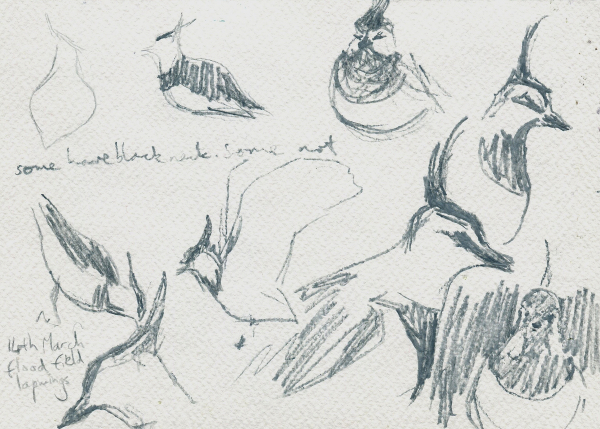
On the return leg of my journey I stopped and spent half an hour sketching four lapwings that probed the sodden ground for worms and beetles and other invertebrates. As far as I can recall it's the first time I've drawn lapwings.

A wind was blowing and head plumes were flicking elegantly skywards. When the birds faced a certain way the plumes blew out of their expected position and created rather a comical impression. I heard the lapwings give their melancholic 'pee-wit' calls but didn't observe any signs of displaying. The first time we saw the tumbling display flight of a lapwing Jennifer and I thought the bird must be in distress, so plaintive were its calls and so odd its movement.


lapwing sketches, coloured pencil on card, 14.5x21cm


lapwing sketches, pencil on card, 14.5x21cm


Five or six pied wagtails or more were hopping and running around the flood field, constantly bobbing their tails up and down. A kestrel flew over and the wagtails darted up and at it to chase it away.


All other wetland birds eligible for the count:

mallard - 7
moorhen - 4

lesser black-backed gull - 1
common gull - 3
black-headed gull - 2


No swans this count. That's not unusual, sometimes they're there, sometimes they're not. But there's one swan that definitely wont be seen again - a fairly young one, plumage still mostly brown, it's been on the canal in Linlithgow for the last few months. It was killed a couple of weeks ago by an alsatian dog, or similar.

I didn't see the incident but a friend did. The dog walker seemed to do little to stop the attack and continued on their way. The SSPCA took the corpse away. A few times I've seen dogs running through the reedbeds and weedbeds that ring Linlithgow loch - what chance have birds of nesting then?!


All non-count birds seen:

skylark - singing intently, high over the Park Farm fields
tree sparrow
house sparrow

reed bunting
yellowhammer
goldfinch
chaffinch

greenfinch
kestrel
collared dove
song thrush - singing, not seen

robin
wren
dunnock
blackbird
magpie
crow
rook
jackdaw
blue tit
great tit

coal tit
starling
woodpigeon


35 species for the day


flood-field, train passing


flood-field, pink-footed geese


Between the Philpstoun bings, the remains of a bridge. Something I keep meaning to paint. I see it as an impenetrable fortress. A few small square windows for those inside to look out from. (My childhood involved a lot of reading of fantasy books!) 


scarlet elf cup (Sarcoscypha coccinea)  in Philpstoun wood


scarlet elf cup (Sarcoscypha coccinea)  in Philpstoun wood


Thursday, 14 March 2013

A London weekend - Manet at the Royal Academy & birds in Hyde Park


Last weekend Jennifer and I were down in London. An eventful journey saw us draw into Kings Cross an hour and a half late. Our first train hadn't started so all passengers were moved onto the next scheduled train - already quite full. Jennifer spent several hours sitting on the floor in first class. I was luckier and found a seat at the far end of the train in the quiet coach. The corridors were too full for us to reach each other.


Galleries
Arriving in London, I went first to the Fleming Collection near Green Park to see a retrospective exhibition of the work of James Morrison. He's a Scottish landscape painter, now in his early 80's and still working from his home in Montrose. You see his paintings in most of the annual Scottish exhibitions - the RGI, RSA, RSW, etc. Large oils, always recognisable as a James Morrison. Painted thinly, almost like watercolour. Loose yet detailed. Amazing skies. Very inspiring.

I re-met with Jennifer and we went together to the Royal Academy to see the Manet exhibition - open until 11pm on Fridays. Members of the Friends of the Royal Scottish Academy get free entry into all RA exhibitions, and get to skip the queues! It was packed inside but when I got close to certain paintings I enjoyed the strength and confidence of brush marks and the high contrast between light background and dark clothing in some of the portraits. Light-dark contrast always entices one to look at a painting more closely.


Birds in Hyde Park
Saturday was great. A couple hours meandering slowly from Marble Arch tube station to the Natural History Museum. Between the station and Hyde park is a massive horse-head sculpture surrounded by road. In Hyde Park there are beautiful Egyptian geese coloured in the ochres and earth reds of Egypt, and other exotic waterfowl. It was interesting to see birds in London parks much tamer than up here. They must be so used to humans being always around.

I was diverted from my walk by a green woodpecker that I faintly heard call. I rarely see these birds so decided the museum could wait awhile. Having wandered in what I thought was the right general direction I heard a second call, a laughing sound just like the green woodpecker's local British name - the 'yaffle'. A different bird yaffled in reply. I spotted one of the pair in the tree beside me, but high above. Backlit by bright grey sky I couldn't make out the soft green body plumage and could only just see the bright red of its head cap.

Whilst looking for the woodpecker a group of jays were flapping and hopping in trees nearby. Three were close enough that if I'd had my binoculars I'd have had a perfect view. Much less flighty than when I see them in Scotland.

The third (disputably) UK bird of note was the ring-necked parakeet. They're everywhere in London. Not known exactly how they first spread to the UK, they're now firmly established and their population in south-east England is thought to be around 30,000. The ring-necks in Britain are now the most northerly breeding parrot populations in the world. When you're in and around London look up if you hear not very pretty squawking and raucous cries (see film clips here). You'll hopefully see a bright green bird (very pretty) with a long tapering tail. A ring-necked parakeet. It's likely you'll see whole flocks of them flying to their roosts as night falls.


pretty pigeons outside Marble Arch tube station


horse head sculpture, Marble Arch


remains of Hyde Park blossom - hawthorn or cherry I think


MuseumIn the museum there were even more people there than had been on our train or in the Manet. I spent most of my time learning from old display cases on the anatomy of birds and collections of British minerals and fossils.


Death at Westminster
Through the ornate fencing of Westminster I spotted a scattering of light feathers around a freshly dead black-headed gull (headless!). It may well have been killed by one of the peregrine falcons that have sometimes nested on the tower of Big Ben. More at www.london-peregrine-partnership.org.uk


Chatting with friends
Back in John's Shoreditch flat we spent the evening chatting and catching up with friends from home who now work in the London area. In the morning I'd done a watercolour sketch of the views from his floor-to-ceiling windows. On John's walls are works from my college years, painted in 2004 - 2006.

 
from John's flat, pencil, pen, watercolour, 14.5x21cm


imagined worlds, on John's walls, from my college days


imagined worlds, from my college days


imagined worlds, from my college days


Tuesday, 19 February 2013

Running a mixed-media workshop, then Beethoven in St Giles.


Last Sunday, 17 February, was a full day. I was leading an all-day mixed-media workshop for members of the Livingston Art Association. Our venue was the excellent studio in the Howden Park Centre.

We started with pencil sketches then worked into them using watercolour, oil pastel, chalk pastel and crayon. Finishing off by using bold black ink. Then people tried painting in watercolour with no underdrawing - a great way to free up one's work. It was a lovely relaxed group and the results were really good.


Sketching in St Giles

In the evening I was back St Giles Cathedral in Edinburgh for the second Sunday in a row. Heriot-Watt Orchestra were playing, after the Heriot-Watt choirs had sung there last week. Both part of the regular St Giles' at Six series of free concerts. The cathedral was packed and the music was great. Beethoven's Symphony No. 7 and a really stirring shorter piece, Coriolanus.

Again I sat at the back and made a sketch. This time in biro:


St Giles Cathedral, Heriot-Watt orchestra, 17th February 2013. biro on paper


Wednesday, 13 February 2013

Pitlochry - courting goldeneyes, red squirrel, second-hand books


Thursday 7th February 2013

I was going to
Frames Gallery in Perth to collect paintings from their Christmas show so I decided to make a railway day of it. I intend to do at least one of my railway days every month, but hopefully more.

I chose Pitlochry, two stops north of Perth and under two hours from Edinburgh. I left Linlithgow at 7.44, Edinburgh Waverley at 8.35, arrived in Pitlochry at 10.19. To make my railway day trips worthwhile I tend to need to leave Linlithgow pretty early, trying to catch one of the first trains departing Edinburgh or Glasgow for the main part of my journey. I like this early start. As I step out of the house it's often still dark, the air is cool and the world feels a new and fresh place. The birds are singing and I walk to the station with a smile on my face.

In the past I got a lot of reading done on trains but nowadays I often just sit and look out the window. There's always something to see, often birds to spot. Sometimes I make quick sketches. I saw my first oystercatchers of the year, a big host of them on the grassland in Burntisland, probing for worms with their long red beaks. The tide was out and on the shore were lots of waders, including quite a number of godwits, too far away to tell if they were bar-tailed or black-tailed. A kestrel was perched in a tree beside the track.

The further north we went the more pheasants I saw strutting their way across the fields. The males stand out well but the sandy brown mottling of the females is difficult to pick up against dead grasses and crop stubble. I watched a male land against a breeze, half hovering, head down. I hadn't seen this action before and was interested by the sinuous shape that his head - neck - chest - underbelly - tail made. A headless scarecrow stood in a field, long arms dangling. A long-dead tree stood alone, solid and tall and fantastically twisted.


train sketches, Edinburgh to Pitlochry, pen, 19x28cm


Reaching Pitlochry I decided to walk the main street to get an overview of the town. This was my first visit. It's nice, what you'd expect of a touristy Scottish town - gift shops, cafes, restaurants, information signs. The highlight was the
second-hand bookshop in a part of Pitlochry Station, part of ScotRail's Adopt A Station scheme. Sadly I only had time for five minutes browsing whilst waiting for my return train. The stock seems extensive and the prices are good. The staff volunteer was extremely friendly... and you can have a coffee while you look! Since November 2006 the bookshop has raised around £80,000 for various local and national charities.

I left the town by passing south over a long and bouncing suspension footbridge that took me past
Pitlochry Festival Theatre and beyond to Pitlochry Power Station and Dam. When the dam was completed in 1951 a fish ladder was required to be constructed alongside to ensure that salmon could still reach their spawning grounds up-river. In most seasons over 5,000 fish pass through. 


suspension bridge over the River Tummel

Like the salmon, though getting less wet, I too moved up-river. I walked along a small stretch of country road, quiet and isolated yet only metres from the A9. I was striding along, probably thinking about birds, when suddenly there on a branch just beside the pavement I saw red squirrel. We both stopped still, surprised, and watched each other for several moments before the squirrel scampered down and moved off a short distance in a bounding run. It scrambled up another tree and stayed there, working busily at a pine cone which it held in both paws and extracted seeds from with its teeth. I could hear the noise as it munched away.


red squirrel


I crossed back across the river on a footbridge below the road bridge. Now I walked on footpaths through the trees, sticking to the shoreline where Faskally Wood met Loch Faskally - a part of the River Tummel, created by the Pitlochry dam. I followed the shoreline for as long as my time would allow but I only had four hours before the train to Perth and I wanted to give myself an hour to paint. It's always a toss-up between exploring and sketching.

The water is slow here and the river is wide. Combined with snow on distant hills and a beautiful winter sunlight it was an enchanting walk.

On the water of the River Tummel and the loch were a variety of birds, though none in great numbers. There were four or five teal - our smallest ducks. And tufted duck and goldeneye and mallard. One little grebe swam like a speck in the distance and a solitary mute swan glided across the calm surface, causing ripples to break the mirror reflections of trees and hills. I saw a dipper perch and fly and perch and fly. When it stood on a stone nearby it sang its burbling chittering song. A cormorant was still as a sentinel on a rock close to the distant shore, beside a yellow buoy.

Birds are behaving differently now that spring approaches. I watched a drama unfold between three goldeneye ducks - two males competing for a female. As the female floated nearby the males swam in a race, necks long, heads held high, flicking their heads back. In courtship goldeneyes flick their heads right back so that their beak points upwards. It looks really odd. One of the males dived, swam underwater and rose directly behind the other, frightening him into flapping a short distance away. At one point they swam on either side of the female, flanking her like the minders of an actress who tries to avoid the press.


Loch Faskally goldeneye studies, pencil, 19x28cm


I chose a solitary beach of shingle, a river beach only 3 metres wide, and spent an hour there using watercolour to try to capture the scene of reflected trees. I wanted a dipper in the foreground, as it had been when it flew past me earlier. White neck and breast shining out against dark upper head, wings, back, and against dark reflections on the water. I've worked it up further back in the studio, in watercolour, gouache, graphite pencil and coloured pencil - I should probably just say mixed media. These days I'm enjoying trying to combine free-er painterly marks with areas of detail.


Loch Faskally dipper, mixed media, 25x35cm


It was difficult to drag myself away but I didn't want to miss my train. I walked back through Faskally Woods to the A9 underpass. From there I walked now on the Pitlochry side of the river, still through nice woodland, until emerging at the north side of the hydroelectric dam. Then five minutes to the station and a further five minutes to browse briefly in the second-hand bookshop.

A good day, and a town to which I shall definitely return. There are walks to be done in all directions.

 
Pitlochry bird list:

pheasant
swan
goldeneye
tufted duck
mallard
teal
dipper
robin
chaffinch
goldfinch
buzzard
little grebe
blue tit
great tit
coal tit
long-tailed tit
wren
goldcrest
cormorant
crow
jackdaw
magpie
woodpigeon
herring gull
black-headed gull
blackbird
bullfinch
heron
goosander
moorhen
rook
redpoll - I need to learn to i.d. these little finches. In this country we can get the lesser redpoll, the common redpoll, the Arctic redpoll. I know no more than that. This one was smaller than a robin, very delicate. Ochre/grey legs. Body darker than legs, but streaked. Some white in the streaking and quite a lot of it on the underside. A daub of red on the forehead, quite bright. Beak and 'bib' area dark, almost black.

32 species


purposeless steps


Loch Faskally sketch spot


dipper studies from photos, 19x28cm


Loch Faskally


in Faskally Woods


Pitlochry hillside through binoculars


Monday, 11 February 2013

Sketching & Song in St Giles Cathedral, Heriot-Watt Choir, Sunday 10th Feb 2013


A post that doesn't fit with my normal themes - no landscape, no nature, no birds...


St Giles Cathedral, Heriot-Watt choir and chamber choir, 10th February 2013. pencil on paper
... but music...


Last night the choir and chamber choir of Heriot-Watt University performed in St Giles Cathedral in Edinburgh. Every Sunday a 6-7pm St Giles' at Six free concert takes place there, anyone can go along.

I really look forward to the two Heriot-Watt concerts there each year - one the choir, one the orchestra. It's a treat to spend a whole hour in such special surroundings, sitting looking and listening as music echoes in and out and around the dark-stone arches and columns.
 
This time I sat at the very back so I could sketch without disturbing anyone, but I had to stop often to listen fully to the music - especially a beautiful spine-tingling solo sung by a member of the chamber choir.


Heriot-Watt concerts are really really worth attending (not just because Jennifer performs in them.) Keep an eye on what's coming up on the Heriot-Watt website or email Steve King, conductor and Director of Music, to be added to their music mailing list - .


Saturday, 9 February 2013

2013 - February BTO waterbird count, Linlithgow - Philpstoun


My monthly BTO WeBS count along the Union Canal, Linlithgow to Philpstoun,

Saturday 9th February.

Start time 8.45am.
End time 12.30pm

A misty day. At no point did sun break through. Airngath Hill was hidden in the mist, making Linlithgow appear as if it may not be situated in the dip of a valley at all. No wind. No rain.

Spring is coming and birds are starting to sing. The song of the chaffinch is one I've been noticing most, I heard them start up about a week ago. Have a listen here, under 'audio', halfway down on right-hand side.

As often, the flood-field was the highlight. Today on and around the water there were:

mallard - 10
widgeon - 125
curlew - 13
oystercatcher - 35
common gull - 3
black headed gull - 204
greylag geese - 5


All other water birds eligible for the count:

mallard - 5
mute swan - 6
moorhen - 2
oystercatchers and widgeon, flood field


assorted grey geese


All non-count birds:

greylag and pink footed geese - 720+, in huge flock that spread across a field to the east of Park Farm, on the other side of the Edinburgh-Glasgow railway line from where my canal walk takes me. It's very difficult to count large numbers of birds and I spent a long time trying to get as close to accurate as possible. It seemed easiest to count them in batches of ten. The undulations of the field made it extra hard and I'm confident that my total is an under-estimate.

The geese were were greylag and pink footed, although I'm not 100% certain of the pink feet - there are also bean geese, which are possible here, though unlikely. Looking through all my books the beans are similar to the pink footed but a little larger in size, taller in stature, and with a significantly larger beak. Both are quite distinguishable from greylag - they have darker and brown rather than grey heads and necks, and lots of darkness on the beak compared to the carrot-orange wedge of the greylag)

During the rest of my walk skeins of geese were quite regularly flying in towards this one field. The largest skien comprised 140 birds, in two or three rippling V-shaped lines.

None of these geese can be included in my WeBS count as I only record birds using the canal, or on field-width on either side of it. We have to strictly stick to the same rules every month.

redwing - but only one, in the woods at the Philpstoun Bings. Funny, because yesterday evening in Real Foods I bought an RSPB redwing pin badge.

pheasant
tree sparrow
house sparrow
yellowhammer
goldfinch
chaffinch
kestrel
buzzard
collared dove
song thrush - as with most of the songbirds, thrushes are starting to sing territorially, in preparations for courtship and mating. In the trees above our house one sings each morning, from really early early. I want the windows open to hear the song even more clearly. Jennifer prefers to have a decent sleep, so we compromise. (i.e. some nights I leave it ajar without telling...)

robin
wren
dunnock
blackbird
magpie
crow
rook
jackdaw
blue tit
great tit
coal tit
starling
woodpigeon
goldcrest (heard not seen)

35 species for the day.


canal count notes, pen on card


And ivy and fungi: 

In the small stand of beech wood just beyond Philpstoun my eye today was caught by this strand of ivy. Fascinating how the creeper slowly crawls up a host tree, securing itself with caterpillar-feet tendrils no more than a few millimetres long.


The small slug-like fungal growths that I looked at last month seem to have grown a little: